
Current EU fishing regulation has it all wrong
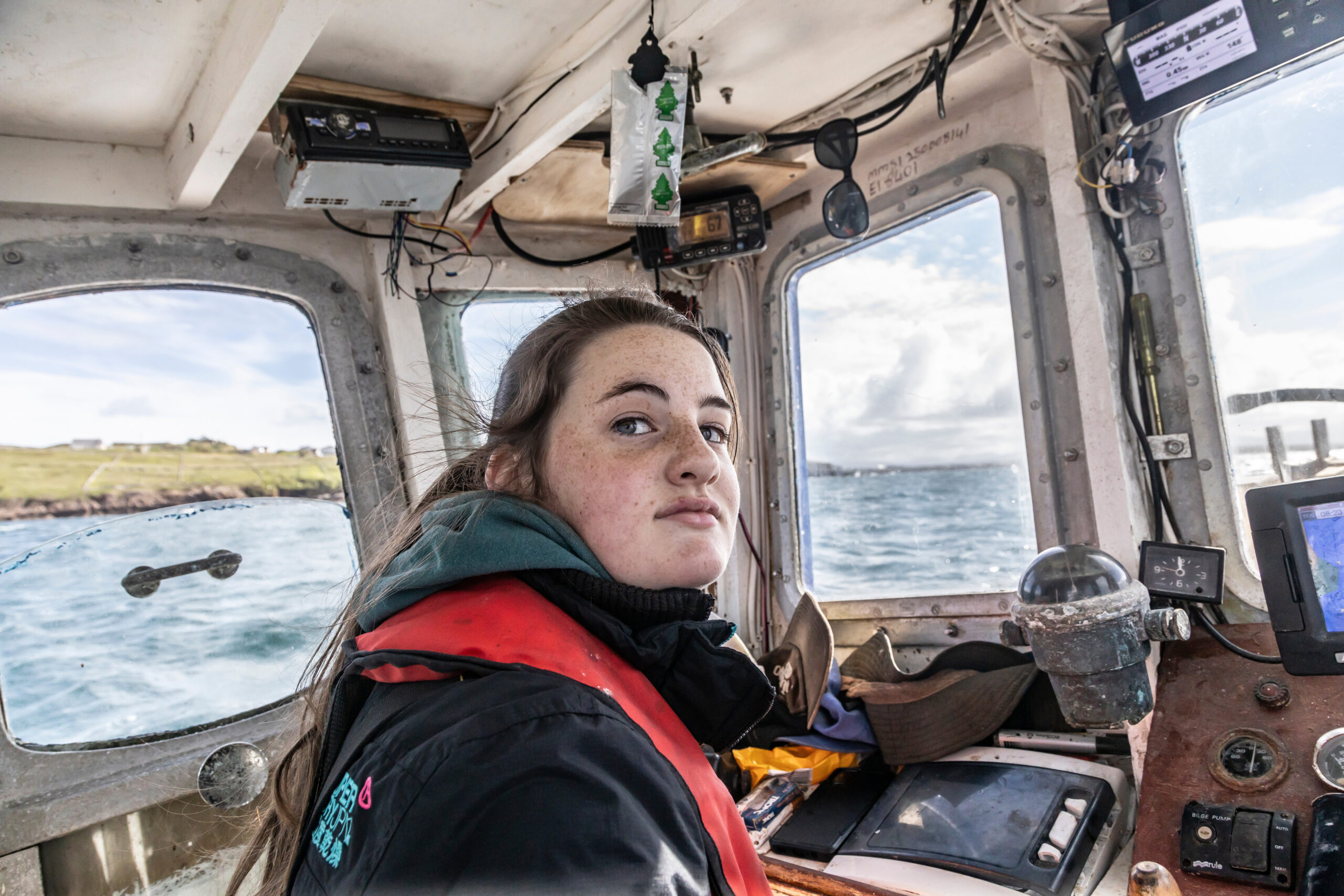
Photo Credit: Oceana
By Muireann Kavanagh, Small-Scale Fisher and Advocate
Voices from the Sea is an op-ed series amplifying the perspectives of small-scale fishers engaged in the Make Fishing Fair campaign. Each month, a fisher will share their experience of working at sea, the realities of small-scale fishing in their country, and what must change to secure a fair and sustainable future for fishing in Europe.
This article is now live on Euractiv
Muireann Kavanagh is a 16-year-old fisher from Arranmore Island, Donegal, and a passionate advocate for Ireland’s island fishing communities. Fishing traditional hook-and-line pollack with her family, she became a national voice after challenging the EU’s zero-catch policy. She is a representative for the Irish Islands Marine Resource Organisation, which campaigns to address inequalities in European fisheries management.
I was born into a fishing family on Arranmore Island, on the Northwest coast of Ireland.
My parents are both from Arranmore, as were their families before them. My father and my uncles are fishermen and small boat owners. My brother skippers one of the island ferries and helps out on our fishing boat on his days off. Fishing is in my blood, and it’s something I love doing.
Arranmore Island, with its rocky shores, high cliffs, white beaches and windswept hills, is my home – one where I wish to stay and earn an honest living from the sea that surrounds us, just like my family has for over a hundred years.
But my birthright has been taken away from me. I have no future in Arranmore when I leave secondary school. There is no work for me, even though our island is surrounded by water with 34 species of magnificent fish. Due to unjust restrictions, there are very few that we are now allowed to catch.
I started fishing with my Uncle Anton several years ago, potting for crab and lobsters in the morning and then going out in the evening with six lines and hooks for pollack. We went out on the 11-metre boat my grandfather James Kavanagh built in 1970 with my great uncle Tully Coll and boat builder Hughie Boyle. They built her on the beach in Arranmore, without any power tools, and she provided for our family and the crews for decades.
Now, she’s hauled up on that same beach, stuck, since the ban on pollack fishing came into force.
The pollack fishery is a very short season and nobody can predict when the fish is going to turn up in the bay, but we were having several good years of it when I was first fishing.
In 2024, everything was suddenly ripped out from underneath us yet again. Based on questionable scientific advice, the Council of the European Union claimed that there was no pollack in ICES area 60 and 70, so the pollack handline fishery was closed. When we’re working in those waters, we can clearly see pollack there. We could continue to fish sustainably, with the small catch that we can take with our lines.
Yet while we sit on the shore, we see 20 or 30 massive factory boats, with large diesel engines and huge nets, out in the water. They can catch in a single haul what we’d catch in a year or more, and they are allowed to be out fishing.
Compare those big factory ships to my small fishing boat with a small engine and six hooks on a line which you can hold with one hand. Surely, it’s obvious which fishing method is more detrimental to the environment and to fish stocks?
The current fisheries management system in the EU does not work for small-scale fishers, like me, my dad and my uncles. We’re left with fewer and fewer options. We’re putting more and more pressure on the crab and lobster stocks now, because there are no other species for us to turn to: every other species is now banned or has an ever-shrinking quota, which we can’t access.
It shouldn’t be on a sixteen-year-old to call for change. I’m at school, I have schoolwork to do, alongside the fishing I love. But having seen my dad and my uncles struggle every year with incoherent rules and regulations – regulations that are failing both fishing communities and the environment – I have no other option.
I’ve been engaging with Low Impact Fishers of Europe, IIMRO and Blue Ventures, organisations that help amplify the voices of small-scale fishers, because our views need to be heard, instead of MEPs just hearing from the big factory fishing companies. I’ve travelled to Strasbourg and to Brussels to meet with members of the PECH committee and other MEPs to discuss our problems.
I’m speaking up for my family, my community and my island.
I want to see MEPs prioritise preserving the traditional fisheries. I want them to enforce Article 17. And ultimately, I want them to strike the right balance that means fishing can continue for centuries to come. That means letting the fishing communities that have stewarded the waters for generations lead the way.
I don’t want to have to spend my time on advocacy. I hope that lawmakers listen and take the action we need now, so that, ten years from now, I can be living the life I should be: out fishing with my family, catching fish in Irish waters and selling them locally.
 English
  Croatian
  Dutch
Dutch  French
  German
  Greek
Greek  Italian
  Polish
  Spanish