
Płeć i zarządzanie w sektorze rybołówstwa w Galicji
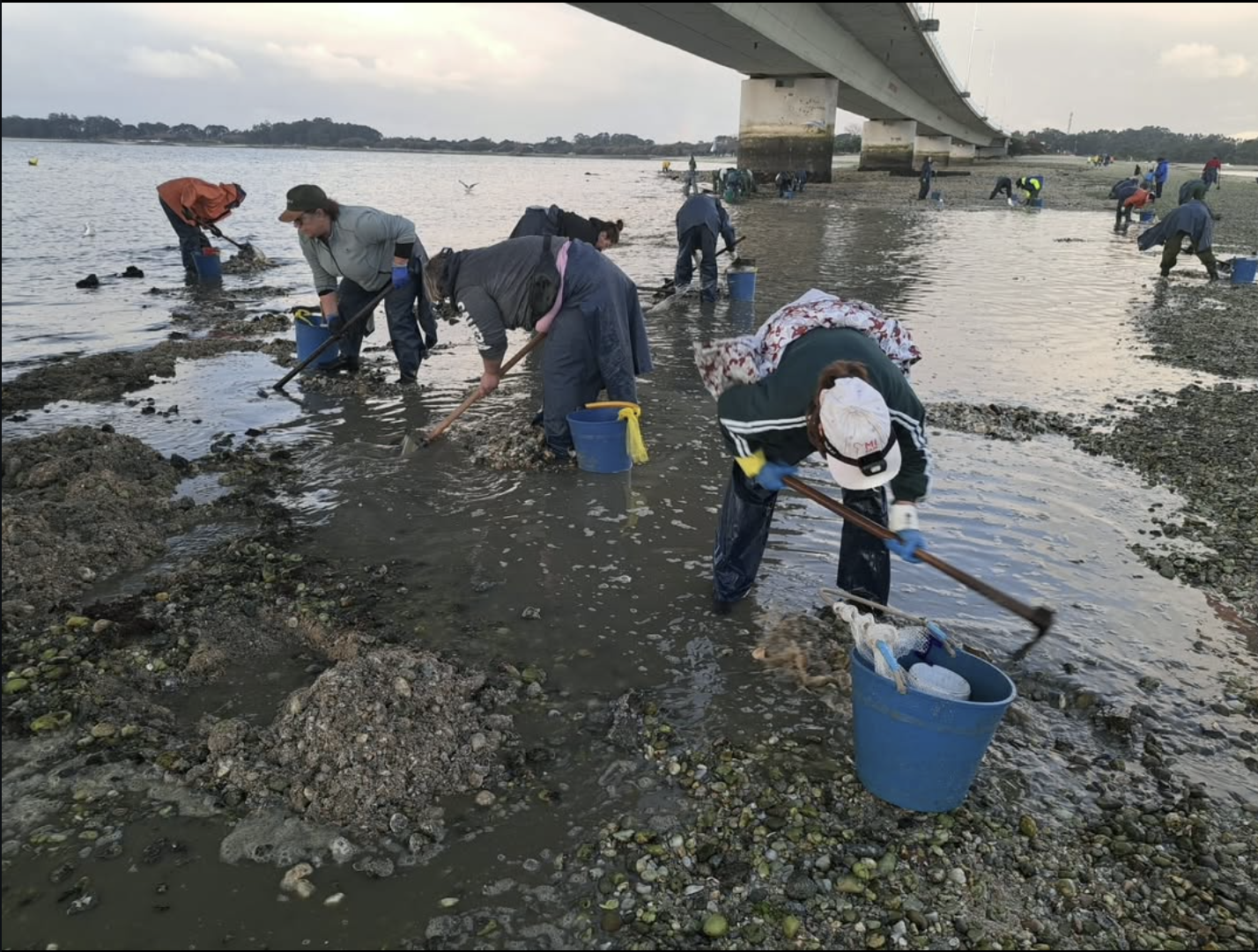
Photo Credit: Mulleres Salgadas
By Sandra Amezaga Menendez, General Coordinator
Voices from the Sea to seria artykułów, które przedstawiają punkt widzenia rybaków małoskalowych zaangażowanych w kampanię Make Fishing Fair. Co miesiąc jeden z rybaków podzieli się swoimi doświadczeniami z pracy na morzu, realiami rybołówstwa na małą skalę w swoim kraju oraz tym, co musi się zmienić, aby zapewnić sprawiedliwą i zrównoważoną przyszłość rybołówstwa w Europie.
I did not set out to work in the fishing sector. I studied Political Science and Sociology, and my first job in a tuna fishing company in Madrid came almost by chance. But that position became permanent, and over time, what began as a practical choice — close to home, compatible with raising a young daughter – turned into a long-term professional and personal commitment.
I now work for an organisation called Mulleres Salgadas. It is the first and only Galician-wide feminist association of women working in the fishing sector, founded in 2016 to give visibility, voice and representation to a group historically excluded from decision-making. Today it brings together nearly 2,000 women from across the entire maritime value chain and works to transform a traditionally male-dominated industry through advocacy, research, training and public action, both in Galicia and at European level. As a member of the European network AKTEA and promoter of the Galician Fisheries Equality Observatory, Mulleres Salgadas aims to make the sector more democratic, inclusive and sustainable, while recognising women’s labour and strengthening their leadership in coastal communities.
My family has always been linked to the sea, but it was through my work that I truly understood the complexity of this world. I started in administrative management, dealing with suppliers across Africa and the Americas, and later joined the management control department, working with tuna vessels, merchant ships and auxiliary fleets in a multinational environment. It was demanding, often invisible work but essential to keeping the system running.
Today, I live in Galicia, one of the European regions most deeply shaped by fishing and shellfish gathering. And yet, paradoxically, these activities remain largely unknown, even to people who live just a few kilometres from the coast. Fishing is still seen as something distant, marginal, or outdated – despite the fact that entire communities depend on it, economically, socially and culturally.
The challenges facing these communities are profound. Productivity in the Galician estuaries is declining. Pollution and waste continue to threaten fragile ecosystems. Climate change is no longer an abstract concept, but a daily reality. At the same time, public policies often prioritise other economic activities – tourism, industrial development, urban expansion – that directly undermine the sustainability of fishing and shellfishing.
What is most worrying is not only the scale of these problems, but the slowness of our response. Adaptation is painfully slow. Dialogue remains limited and exclusive. Key social actors – women’s associations, environmental groups, local organisations – are often kept out of decision-making processes that directly affect their lives and work. There is a kind of institutional immobility, a resistance to plurality, to negotiation, to shared responsibility.
For women in particular, the situation has not improved – it has worsened. There are no real feminist policies in the sector. Gender analysis is absent from official diagnoses. And this absence has consequences: poorer management, less innovation, and a systematic waste of talent, experience and knowledge.
The more you understand the sector, the harder it becomes to remain a passive observer. The sea is not just an economic resource; it is a collective heritage, a social space, a way of life. Protecting it means protecting people, cultures and futures. This reality pushed me towards activism
Activism, however, is not heroic. It is mostly slow, frustrating and exhausting. There are moments of deep fatigue, when it feels like hitting a wall again and again with no visible result. There is personal criticism, disqualification, and sometimes isolation. But there is also solidarity, learning, and the occasional small victory – enough to remind you why you started.
If I could ask for one concrete change, it would be gender parity in leadership and representation across fishing institutions. Not as a symbolic gesture, but as a structural transformation. Because parity is not just about fairness; it improves working conditions, strengthens decision-making, and brings neglected perspectives into the centre of policy.
The barriers to this change are not only institutional. They are cultural, economic, political and even familial. They operate at every level. But they are not immutable.
The future I imagine is one where decision-making tables are plural, informed and environmentally conscious. Where women of the sea are not only praised in speeches, but visible in power structures. Where sustainability is not a slogan, but a shared social project.
This future will not be built by governments alone, although their role is decisive. It also depends on citizens being informed, critical and demanding. On refusing superficial narratives. On insisting that public policies protect not only economic growth, but the professions and ecosystems that have proven, for generations, to be both sustainable and valuable.

 Polish
  English
  Croatian
  Dutch
Dutch  French
  German
  Greek
Greek  Italian
  Spanish